

ElevenLabs Unveils Faster, More Accurate Speech-to-Speech Models


Precision and speed are no longer mutually exclusive. That's what ElevenLabs aims to prove, announcing on Tuesday, October 20, a new family of speech-to-speech models. The Polish-founded startup says it has developed a conversational model, Eleven Realtime v1, that delivers highly accurate responses with minimal latency. This new family also responds in a more human-like way (handling pauses, interruptions, and turn-taking), allowing companies, at least in theory, to offer more natural-sounding voice agents.
The new family supports up to 90 languages and can use the 17,000 voices in the ElevenLabs library.
A family of two models
ElevenLabs is actually launching two different models:
- Eleven Realtime v1 Mini: Designed for simple natural language conversations where latency is the top priority. ElevenLabs says it's sufficient for most use cases.
- Eleven Realtime v1 Max: For tasks where reasoning and accuracy matter most. Customer service, agent workflows, and more—the model is ideal for use cases that require multi-step reasoning (with tools, for example).
Both models have been trained to be true native voice agents. Until now, using ElevenLabs for voice AI required several models (speech-to-text, LLM, text-to-speech, etc.). That era is now over. The new family covers the entire process with a true speech-to-speech model.
Max outperforms Mini, except in conversational flow
Scores for the two Eleven Realtime v1 models, in %
Voice reasoningBig Bench Audio
Conversational dynamicsFull-Duplex-Bench
Tasks with tool callsSuccess rate
Eleven Realtime v1 Max
Eleven Realtime v1 Mini
Source: ElevenLabs, independent evaluation by Artificial Analysis, October 2026.
In benchmarks, Eleven Realtime v1 Mini reaches 75.9% accuracy in voice reasoning (the ability to answer voice questions, Big Bench Audio by Artificial Analysis). Its big brother, v1 Max, scores 98.8%. That puts it ahead of Grok Voice 3.0 (98.5%) and Gemini 3.8 Live Extended Thinking (97.7%), nearly topping the benchmark. For conversational dynamics (how much it feels like talking to a human), Mini scores 95.8%, slightly higher than Max (94.1%), and on par with OpenAI's GPT-Realtime 2.1. For tasks that require calling tools, the gap widens: Max succeeds 87.1% of the time, compared to 60.3% for Mini. In the Speech Agent Arena, where users compare two models blind, Max scores 998 points and Mini 988.
Finally, on latency, Eleven Realtime v1 Max responds in 470 milliseconds, and Mini in 500. For comparison, Grok Voice 3.0 responds in 810 milliseconds and GPT-Realtime-2 (High) in 1.14 seconds. On paper, these are excellent results given the level of accuracy.
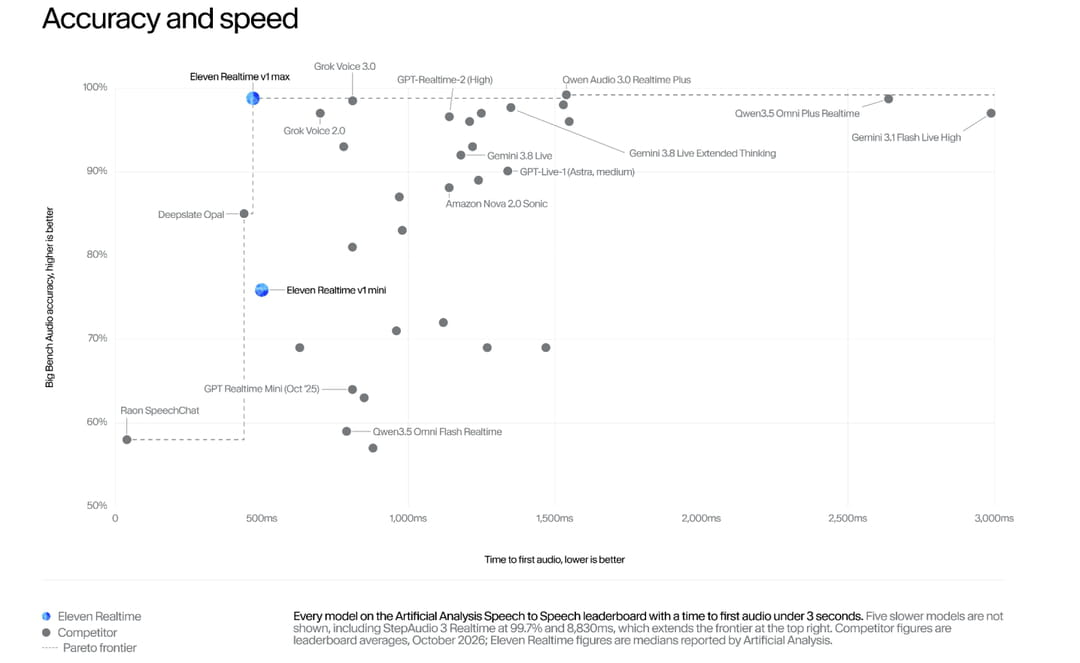
On the Artificial Analysis chart, no model is both more accurate and faster than Max: it offers the best balance between accuracy and latency.
An OpenAI-compatible API
The family is available starting today on ElevenLabs, with access in ElevenAgents (deployment by phone, web, WhatsApp, or contact center platforms), and via the company's Realtime API over WebSocket (WebRTC is not supported at launch). The API is fully compatible with OpenAI's Realtime API: to migrate a voice agent workflow from OpenAI to ElevenLabs, you just need to change the endpoint (the API call address) and the model name, and the OpenAI SDK works as is.
On pricing, ElevenLabs says that in ElevenAgents, the Realtime models follow standard per-minute pricing: the model selector displays an estimated cost per minute. Through the Realtime API, the company charges per minute of connected audio, plus tokens, with the token price staying the same regardless of the plan. The per-token price has not yet been announced as of this writing.
With a growing presence among major European groups (Deutsche Telekom, Revolut, Klarna), this new launch gives ElevenLabs real growth potential. Having a family of models that are both accurate and fast allows companies to consider real-world production use cases for voice agents: customer service, tech support, tutoring, sales advice, lead qualification, and more. The only limits now are creative possibilities and cost. There's real revenue to be captured from legacy European companies, which still struggle to adopt voice agents already widely deployed in production across the Atlantic. And ElevenLabs appears to have understood this well. Large organizations now account for 55% of its revenue, up from 40% twelve months ago.
This article was automatically translated from French. Read the original version: https://www.journaldunet.com/intelligence-artificielle/1556891-eleven-realtime-v1-max-98-8-de-precision-en-470-ms-le-pari-speech-to-speech-d-elevenlabs/