

Vera Health Raises $28.5 Million for Its AI Assistant Used by 800,000 Clinicians

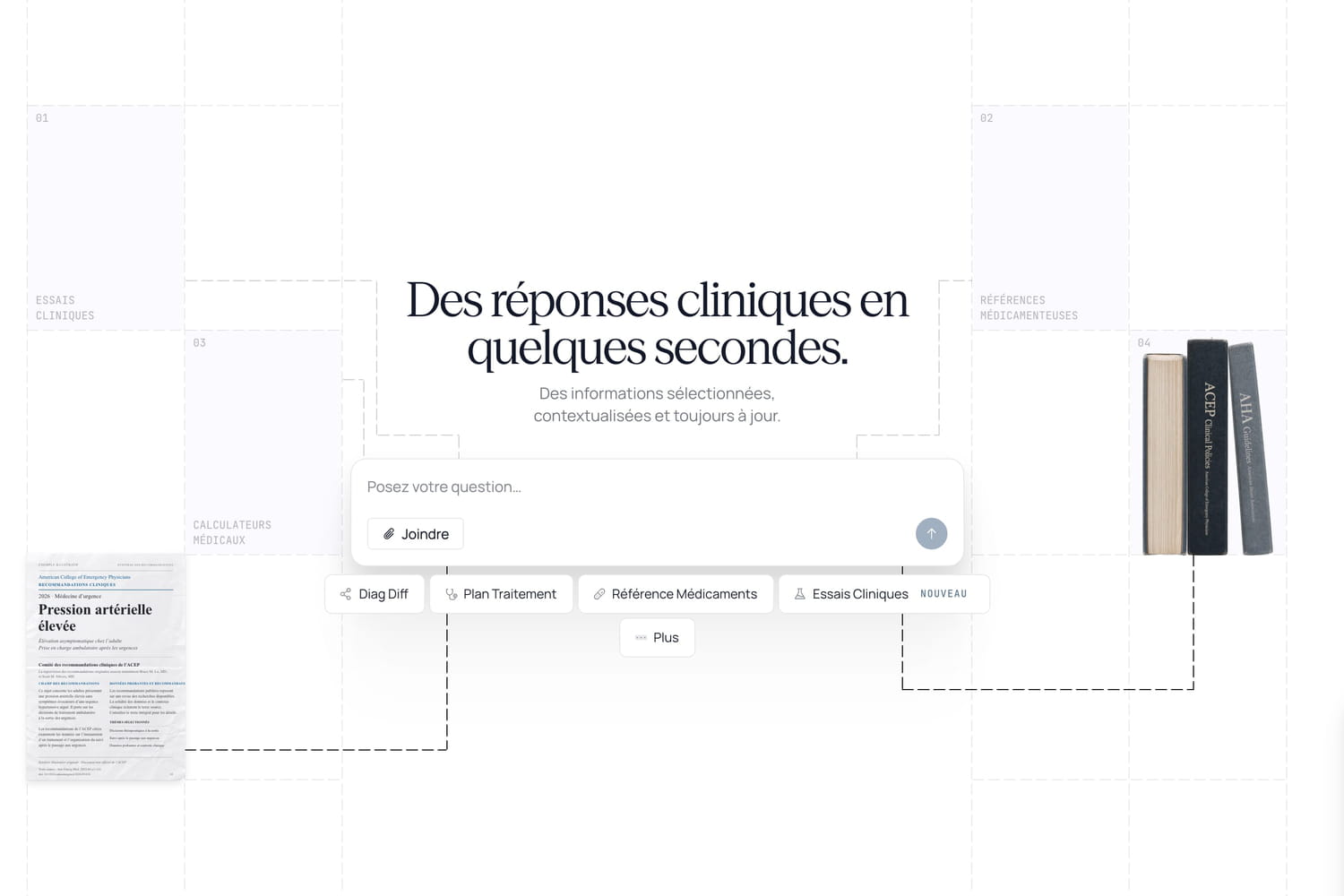
Healthcare remains one of the most promising fields for AI. Vera Health has decided to go all in. The startup, co-founded by two French entrepreneurs, Maxime Allouch (an MIT alumnus) and Taieb Bennani (who studied at Yale and MIT), has developed an artificial intelligence solution dedicated to healthcare professionals. On Tuesday, October 27, it announced a $28.5 million Series A round led by Threshold Ventures, with participation from Optum Ventures (UnitedHealth Group), Mantis VC, and SV Angel, bringing its total funding to $32 million. Y Combinator and Gradient (an AI-focused seed fund launched by Google) also contributed. "There's no debt: it's 100% equity," Taieb Bennani told JDN.
An AI Solution for Healthcare Professionals
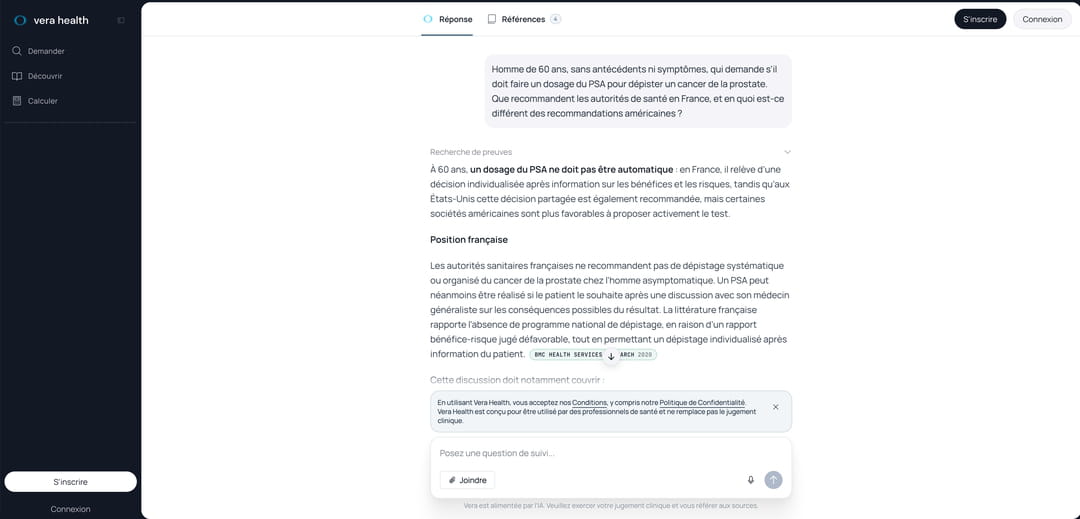
Vera Health is, simply put, a kind of ChatGPT for healthcare. The San Francisco-based startup offers a conversational interface tailored for medical professionals. Unlike general-purpose consumer assistants, Vera Health provides a chat interface with answers sourced from over 60 million medical documents (peer-reviewed publications, best practice guidelines, drug information). It relies on AI agents combined with RAG on its dataset to deliver the most reliable and accurate answers possible. Under the hood, Vera doesn't use just one model. "For each question, more than five different models work together: one understands the question, another ranks relevant passages, another drafts the answer, and another checks it," explains Taieb Bennani.
To rate the reliability of each source, he describes "something like Google's PageRank, rebuilt for medicine." Instead of simply giving an answer, the AI cites its sources (from scientific material) and provides a reliability score calculated from the scientific methodology of each cited study. The AI also takes national context into account and prioritizes recommendations from local authorities (such as the Haute Autorité de santé in France). The database is not static. "New literature is integrated daily, and recommendations from medical societies are re-checked every week," says Taieb Bennani. Retracted studies are excluded. And to catch errors, "judge" AIs, trained on ratings given by doctors, review a sample of real answers every day.
The company now has 800,000 users worldwide (up from just a few thousand in October 2025), including one in seven doctors in France. Word of mouth has fueled its growth, helped by the fact that it's free: all healthcare professionals can use it at no cost. The business model is not straightforward. Vera Health generates revenue from third-party integrations with healthcare institutions. Hospitals, clinics, and practices can use Vera Spaces, its paid offering, to upload documents (internal protocols, guidelines, etc.), integrate patient records with the AI, or automate certain clinical workflows. "We don't display ads, and no partner can alter an answer, its sources, or its level of evidence," he says. "Doctors' trust is our most valuable asset."
A Team of 12 Employees
More surprising than Vera Health's growth curve is the size of its team. The startup currently employs twelve people and achieved most of its growth with just six, outpacing competitors that reportedly raised up to fifty times more, according to the company. "Our R&D is based in San Francisco and, fun fact, it's mostly French," says Taieb Bennani. In France, "we're developing new products that will use HDS hosting, and the process is already underway."
The funds raised today will mainly be used to expand the medical knowledge base of its AI system. The startup also plans to work on more personalized answers tailored to each country's context and to increase partnerships with medical societies and regional healthcare institutions.
This article was automatically translated from French. Read the original version: https://www.journaldunet.com/intelligence-artificielle/1557223-vera-health-boucle-sa-serie-a-et-porte-ses-fonds-leves-a-32-millions-de-dollars/