

French PhD Students Use AI at Their Own Risk Amid Lack of Clear Rules

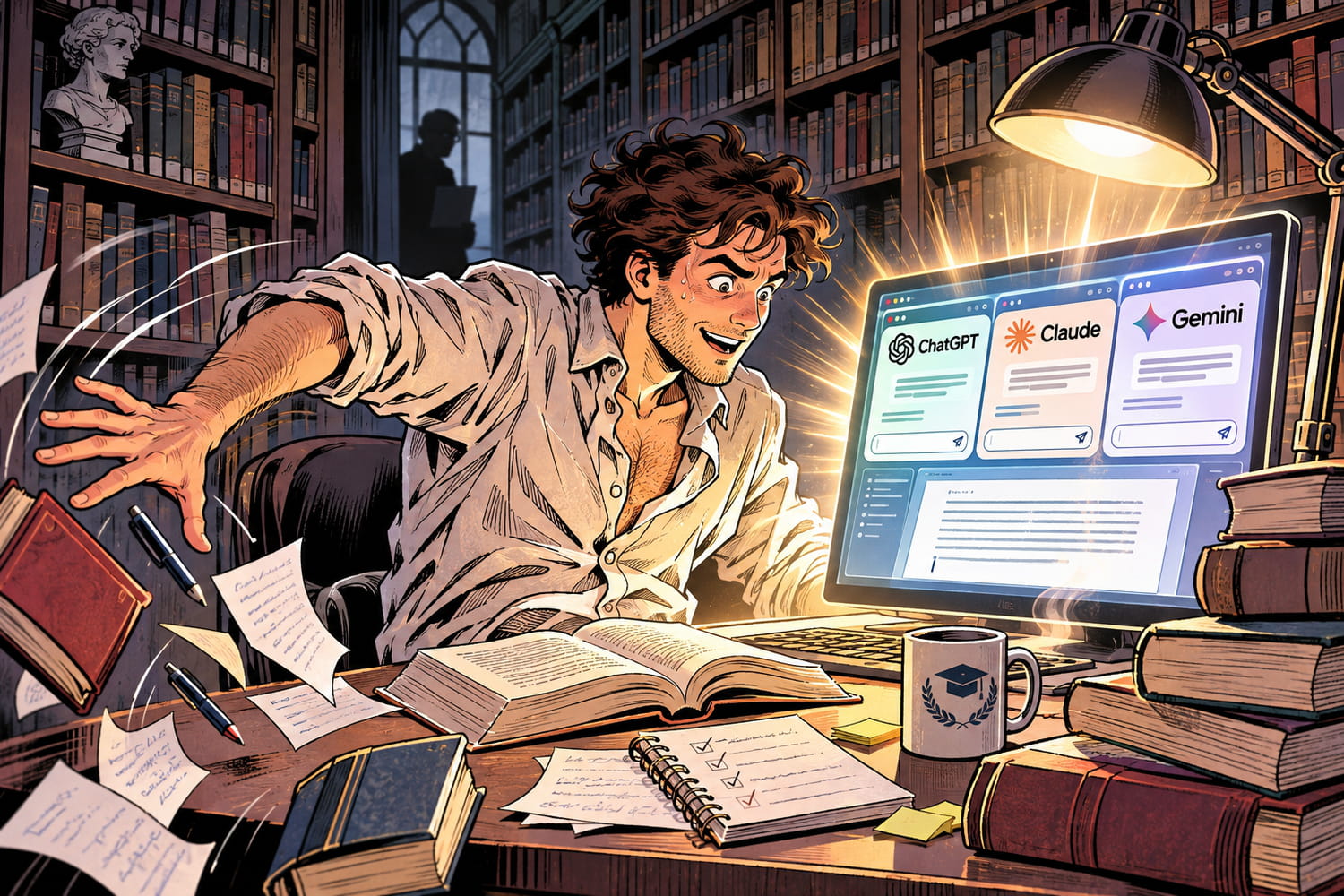
The literary season, shaken by the Thélyson Orélien affair—an author accused of using AI to write his latest novel—has heightened a fear among PhD students: that they too will be suspected of having written their dissertations with AI. "I think we're all a little afraid. Every PhD student who uses AI wonders if they'll one day be questioned about it, if they'll be accused of not respecting the scientific integrity required for this kind of work," Jimmy Kolbe-André, a PhD candidate in public law at Université Paris-Panthéon-Assas, told us. And with good reason. While academia accepts the use of AI to facilitate research, it remains much more reserved about its use in writing doctoral dissertations. "For now, for PhD students and researchers, the rules are unclear on this issue," confirms Anthony Kischel, now a postdoctoral researcher in neuroscience at the Polish Center for Technology Development.
A lack of shared rules
"Personally, I use AI every day for my dissertation. And maybe there will be a problem when it's time to defend it. But that shouldn't be the case, since everyone around me knows about it, including my dissertation advisor. I've even given talks on how to integrate AI into research work. So I'm not hiding it. (...) And besides, most PhD students use AI—it's an open secret," says Jimmy Kolbe-André. While his university is "relatively permissive" on the subject, not all PhD candidates are so lucky. Most of them "are flying blind," he says. Each adapts their use of AI based on their own views or what their advisor allows.
For Pauline Elie, a PhD candidate in law at the Ecole des Hautes Etudes en Sciences Sociales in Paris, using AI is out of the question. "I have a pretty clear and strict position. I don't use AI at all for writing." For her, writing a dissertation with AI means losing ownership of a project carried out "with pride and personal motivation. (...) And with AI, the result is always smooth, disembodied, very bourgeois." Anthony Kischel is less radical but shares a similar view: "If a PhD student asks AI to polish a text they've written—to improve grammar or paragraph structure—that's not a problem. But if they ask AI to write an entire paragraph, that's unacceptable." On the other hand, Jimmy Kolbe-André fully embraces using AI to write his dissertation: "I give AI a list of bullet points, and it suggests a draft. Then I rewrite it, because the draft is rarely good. It's an iterative process."
"Still, it would be better if there were clear guidelines explaining what is or isn't allowed," complains Anthony Kischel. "There really should be a regulation or law to clarify the situation, so we can rely on a written text," says Jimmy Kolbe-André. "As long as there isn't one, there will only be different approaches." Worse, this legal uncertainty is pushing some PhD students to drastically limit their use of AI, out of fear that future regulations might ban it and undermine their work, according to Anthony Kischel. "I know that some people don't use it more widely because they don't know what will be accepted in the future. Maybe, later on, some doctoral schools will completely ban AI. To avoid having their PhD called into question, they avoid using it too much—out of fear and caution."
However, a consensus is emerging around one practice: openly acknowledging the use of AI in a dissertation by including an appendix detailing how it was used. "I saw this in a dissertation defended at Assas a year ago. In an appendix of about ten pages, the author explained that he had used AI for sourcing, the bibliography, footnotes, and so on. But it was not for writing the main text." This is also the approach recommended by Lonni Besançon, associate professor in data visualization at Linköping University in Sweden. He allows his PhD students to use AI only "in a phase where they are improving the text they have already written." He draws inspiration from the practices of many international scientific journals, where his students publish the articles that will make up their dissertations. "Today, most of these journals accept the use of AI as long as it is not for content creation and as long as it is disclosed in the article."
A blurry threshold for acceptance
However, this transparency does not convince Anthony Kischel. "Maybe in a few years, these journals will declare that all articles where AI was used must be withdrawn. That is a real fear for some people." Another issue: at what point does AI assistance become unacceptable? "There is still a gray area around what it means to use AI in writing a dissertation. There is uncertainty about the level at which it is allowed or not," admits Lonni Besançon. This concern does not trouble Jimmy Kolbe-André: he has no problem with using AI for writing as long as the ideas developed in the dissertation remain those of the doctoral student. "People might criticize me later for having used AI. But it wasn't forbidden, and those were my ideas. And what would they criticize me for? For the way the title or footnotes are worded? For the structure, the writing, the bibliography? (...) Can we really set a threshold where it stops being your own thinking and becomes the AI's? That seems complicated to me," he wonders.
And then... it's hard to detect the use of AI, even with Pangram, the tool that led to Thélyson Orélien's exclusion from the Goncourt Prize. "It's very difficult to detect and prove this kind of use. Even if a text is watermarked, you can never prove 100% that a piece of writing was generated by AI. When my AIs generate text that I don't edit, my Pangram tests don't even pick up any trace. Now, what will matter for researchers is not the process, but the result." In this context, it's hard not to ask a fundamental question: "I have a PhD student who is wondering what the point of being a researcher is, when AI can do so much for him..." concludes Lonni Besançon, with a note of discouragement.
This article was automatically translated from French. Read the original version: https://www.journaldunet.com/intelligence-artificielle/1557579-ia-faute-de-regles-les-doctorants-l-utilisent-a-leurs-risques-et-perils/