

Why Supermarket Refrigerators Remain Easy Targets for Hackers

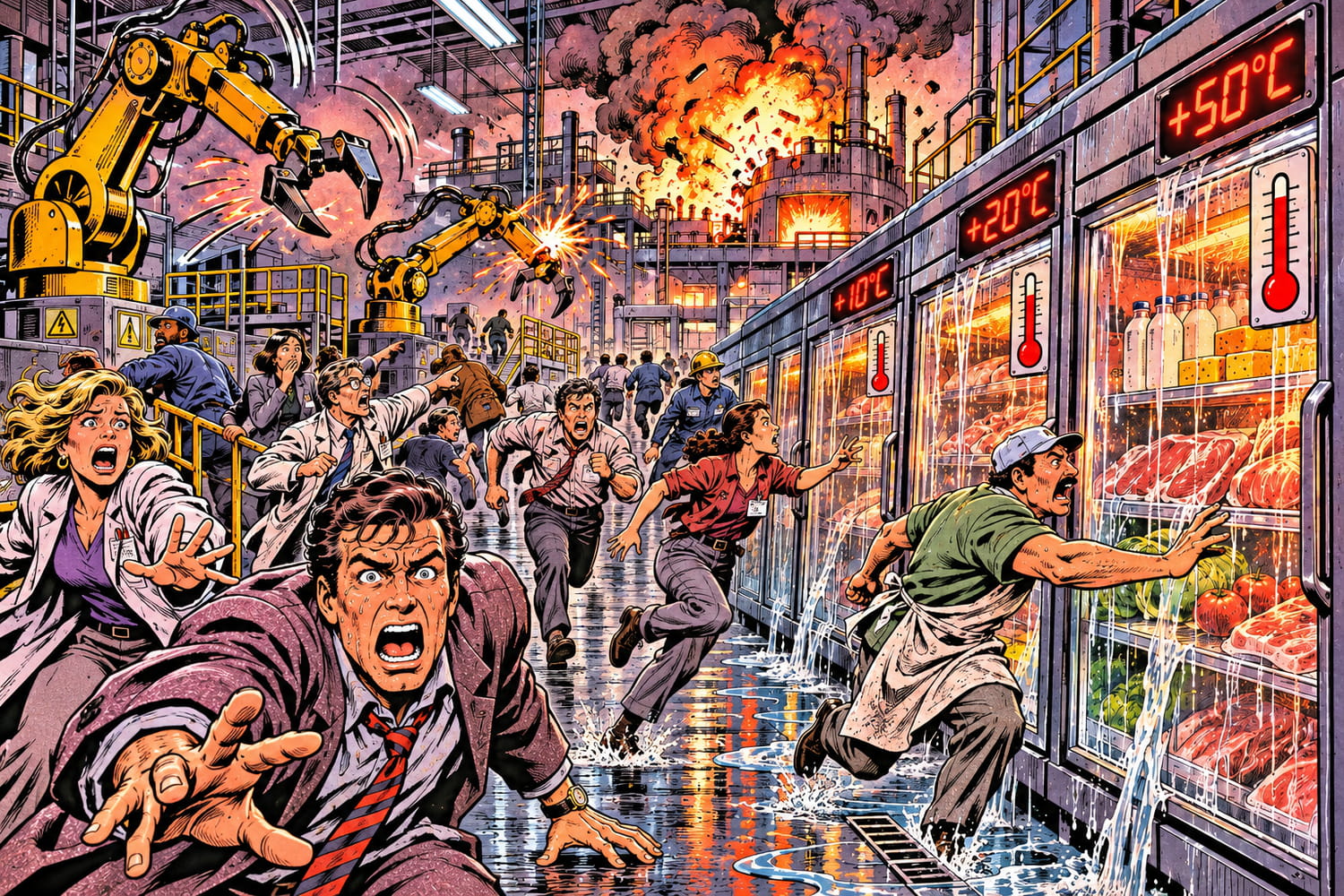
Cold storage rooms at the Etablissement français du sang, supermarket refrigerators... The latest targets of cyberattacks on operational technology (OT) are chilling—literally—and highlight just how hard it is to secure these systems. In industry, these challenges are relatively new, according to Olivier Daloy, Ciso in residence at Zscaler and former CISO at Faurecia, the automotive supplier. "OT systems were never designed to be connected in the first place. Then, in the early 2020s, everything sped up. We started connecting machines to each other. Then we hooked them up to Ethernet, but not to the rest of the IT network. Finally, we gradually connected everything to IT," to avoid multiplying networks.
A cyberattack can now be catastrophic. "An attacker could remotely raise the temperature of an industrial oven and make it explode, or trigger a malfunction in a connected robot—which could be fatal." Despite the severity of these risks, the industry is struggling to fix its cybersecurity weaknesses.
The fear of patches that cost (way) too much
"We have clients for whom we manage security across multiple factories worldwide, running 24/7. Applying a patch to their machines after discovering vulnerabilities means shutting down production for at least 24 hours," says Christophe Bianco, VP cyber services at Thales and OT security expert. The result: "The production manager refuses the patch. Especially in food processing, for example, a production stop requires a deep cleaning of equipment to prevent bacteria. But one day, attackers will exploit this vulnerability. The incident will last much longer than 24 hours..."
Some cybersecurity measures are simply impossible because of the costs involved, notes François Ehly, external CISO and senior manager at Almond. When he worked in the space sector, he had to secure an environment from which rockets were launched. "Changing anything in that environment, like applying updates, meant launching a rocket to make sure everything still worked. That was out of the question given the costs... So a lot of basic actions, like vulnerability management, just can't be done."
A disconnect between IT and OT
"And in OT, people are nervous about touching the equipment because it's so fragile. When I asked to test them before putting them into production, my CIO was afraid they wouldn't work afterward," adds Olivier Daloy. "It's like being afraid to brush your teeth because you might lose them," jokes François Ehly. This fear often leads to conflict between CISOs and industrial managers. "Once, a client even invited us to a meeting with both IT and OT managers to try to reconcile them, because there were communication problems between the two sides," says Check Haris, digital manager at ABB, the industrial automation company.
The industrial manager is often wary of the CISO's requests, fearing they'll disrupt equipment operations. "A CISO who warns the OT manager that their machines are at risk can face three different reactions. If the OT manager has already experienced such an incident, or works in a regulated sector, they'll listen. But if they've never had a cyber incident, they'll completely ignore the CISO's warning. And when they don't ignore it, they'll explain that operations can't be expensive and that the CISO isn't allowed to send requests to the programmable logic controller—the device that links the network to the machine," says Olivier Daloy. Such constraints, he complains, amount to bargain-basement equipment security.
Few experts available
This disconnect between IT and OT can be eased by bringing in industrial cybersecurity specialists who understand both worlds. The problem: they're rare. "And on top of that, they're often specialized in the security of a particular brand of equipment. In IT, finding a Palo Alto firewall specialist is no problem. But in OT, finding someone who knows the security of a specific Rockwell device? Good luck!" warns Olivier Daloy.
Security through obscurity
Industrial managers also face "security through obscurity" from equipment suppliers, according to Christophe Bianco. "The code and operation of machines are often not public, because these are proprietary environments. Good cybersecurity management is based on understanding vulnerabilities and fixing them, but equipment makers don't always disclose vulnerabilities that only they know about. Fortunately, the Cyber Resilience Act will require them to track these flaws." However, this regulation only applies to equipment placed on the market after it takes full effect in 2027. Industrial machines are often used for decades. Many will therefore not have guaranteed vulnerability tracking, even after 2027.
Physical security is a challenge
Finally, it's often hard to physically secure connected equipment, making them easy targets for malicious actors. "Many OT environments have exposed physical interfaces. That's the case, for example, in renewable energy. Solar panels or wind turbines are often spread out over large areas. These sites are impossible to secure physically. State-sponsored attackers or hacktivists can easily connect to wind turbines. To a lesser extent, the same goes for large factories," says François Ehly. The NIS 2 directive fortunately calls for stronger physical security for this equipment. The hope is that its implementation won't be delayed... but that's far from certain!
This article was automatically translated from French. Read the original version: https://www.journaldunet.com/cybersecurite/1558067-pourquoi-les-frigos-des-supermarches-continueront-d-etre-facilement-pirates/